
Trace Aliso Viejo Streets by Address
An address trail works as a chain, never as one name search. Begin with the physical address. Then move through GIS and the APN. Follow assessment data, a deed index, voter rules, and reverse directories in turn. The chain reveals how a parcel is identified. It shows who appears in a title record. It also shows where notices get sent and which names were once listed at an address. It cannot turn an owner into a full household roster. Nor can it do so for a mailing recipient or a voter.
- Confirm the full delivery address and keep the street number, directional, unit, and ZIP spelling intact.
- Open the OC Public Works parcel map, locate the address, and click the parcel to capture its APN.
- Enter that eight-digit APN in the Orange County secured-value search. Save the situs, value components, exemptions, and roll date, while noting that the online result omits the owner name.
- Use the APN, tract, and legal description to find a current acquisition deed or transfer in RecorderWorks, then read the recorded copy rather than treating the index as the deed.
- Check voter information only through the voter’s own authenticated lookup or a qualified file request. It is not a public street browser.
- Ask the Aliso Viejo Library or Orange County Archives about reverse-directory and newspaper holdings, then compare any listed occupant with the deed and parcel trail.
Order matters here. A street name can point to dozens of parcels at once. An APN plus a legal description gives the county records office a stable anchor instead. What emerges is a defensible address history. It is not a claim that every person at the address has been found.
Aliso Viejo Street Records by Address
Different custodians answer different questions along an Aliso Viejo street. GIS supplies the location and parcel shape. The assessor supplies APN-linked roll data, though the free site stays deliberately narrow. The Clerk-Recorder holds the title instruments. The City holds local permits dating from incorporation, and the voter file is controlled by identity and permitted purpose. Reverse directories can add a historical listed name. Their coverage gaps and opt-outs must stay visible. They never amount to a full address census.
| Record Set | Keeper | Street Evidence | Access |
|---|---|---|---|
| Assessment roll | Orange County Assessor | APN, situs, value, exemptions; owner omitted online | APN web search or counter |
| Parcel GIS | OC Public Works | Parcel shape, APN, streets, mapped context | Free interactive viewer |
| Recorded deeds | Orange County Clerk-Recorder | Grantors, grantees, dates, legal descriptions | Free index; copies by request |
| Tax bill | Treasurer-Tax Collector | Tax status, installments, delinquencies | APN or bill-data tools |
| Permits and plans | City or county | Address, applicant, contractor, work dates | Counter or focused request |
| Voter file | State and county election offices | Controlled residence and precinct fields | Self-lookup or qualified request |
| Reverse directories | Library, archive, or source publisher | Listed occupant or business at an address | Reference inquiry; holdings vary |
Use the parcel as the bridge. A tax record is not a title record. A deed is not an occupancy census. A permit applicant may simply be a contractor. This division of labor is why an Aliso Viejo address search works best as linked evidence, with a date and a custodian beside each entry.
Aliso Viejo APNs and Address Records
The free Orange County Secured Property Value Information portal accepts an APN and nothing else. Street addresses and owner names will not work there. The input must be exactly eight numeric digits. Return values can include the assessment-roll year, situs or location details, land and improvement values, exemptions, and related secured-value fields where present. The online notice says plainly that owner names are excluded. That makes an address-to-APN match only the first step of any ownership inquiry.
| Field Label | Type | Required | Format Notes |
|---|---|---|---|
| APN | Text or numeric | Yes | Eight numeric digits; retain leading zeroes |
| Submit | Button | Action | Returns secured-value information for that APN |
The current public roll closed on January 1, 2026. A later transfer may not appear in the annual web result. The Assessor lists a Public Service Counter at 500 South Main Street, second floor, Orange. It is open weekdays from 8 a.m. to 5 p.m. for fuller lawful roll information. A county directory phone channel is listed at 855-886-5400. A targeted public-record or data request is another route. Name the APN or record series rather than asking staff to build a resident list. Older assessment maps may sit in archival holdings. Confirm the series before relying on them.
The Assessor's property-information and parcel-map guidance pairs the roll with counter and map access. An exemption can support a tax claim tied to a principal residence. It still does not identify every adult, child, guest, or other occupant at the parcel.
The county's parcel-map guidance shows the counter and map route when the online APN result is too thin.
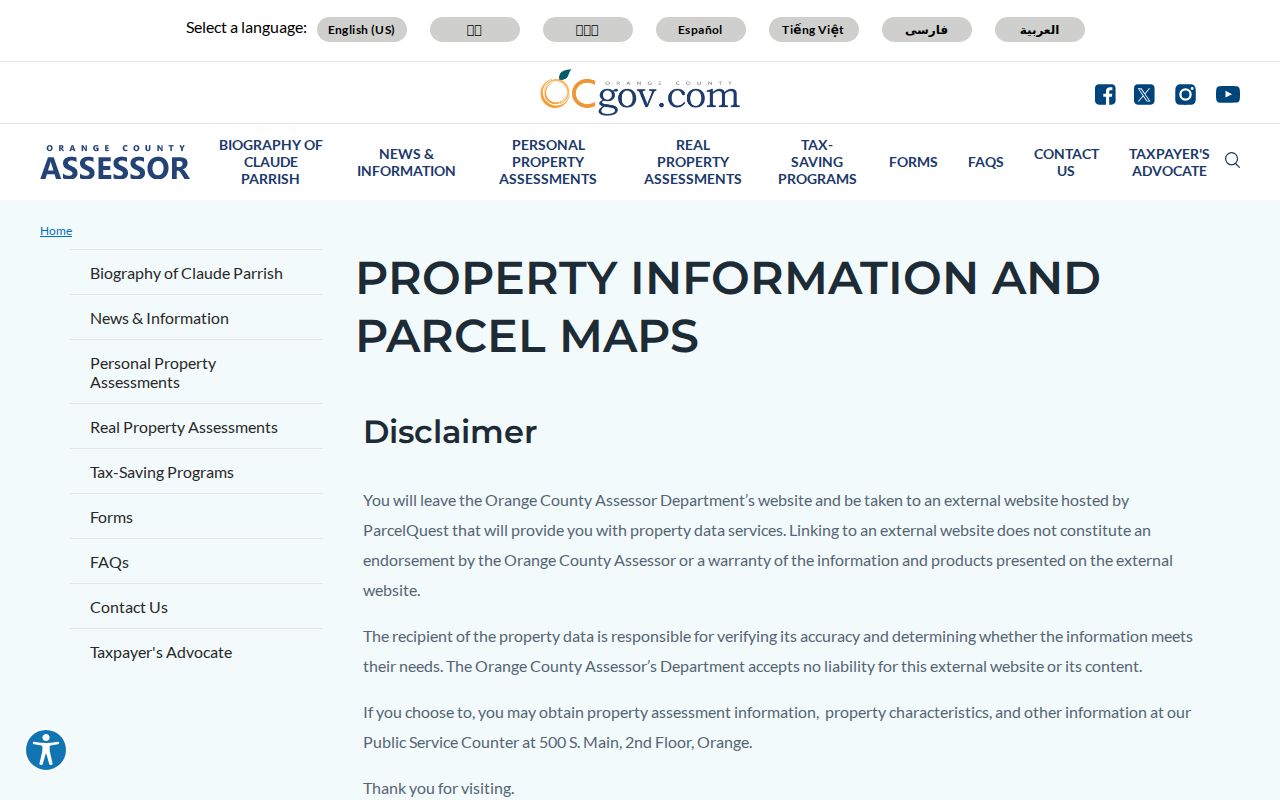
The assessor map helps identify the parcel. The secured-value page does not provide a web-based owner-name search. One tool places the land; the other prices it.
Note: Treat an annual assessment result as a dated roll snapshot, not a live title feed or a complete Aliso Viejo address directory.
Aliso Viejo Parcel Maps for Street Records
The OC Interactive Map is the spatial step the assessor portal lacks. Locate by address or APN. Pan and zoom until individual polygons appear. Click a parcel, and copy the APN into a research note. Expect a layer list, basemap, and print control. Streets, parcels, municipal boundaries, zoning, aerial imagery, districts, and survey or recorded-map references appear in the interface.
The full layer inventory is not published. So a street search should record only what the map actually displays. Test city jurisdiction against the municipal boundary, not the mailing city line. Orient the search with the parcel shape, but never claim title from it. Adjacent polygons may be common areas, private roads, or land under a different association.
A map click earns its keep in certain cases. A street may curve. A unit may share an address. Or a parcel may sit near the city edge. Save the APN and the map date. Then move on to the assessor and the Clerk-Recorder. The GIS viewer is a location aid. The recorded document supplies the legal description and title evidence.
The county's OC Interactive Map gives the Aliso Viejo address trail a parcel-by-parcel frame.
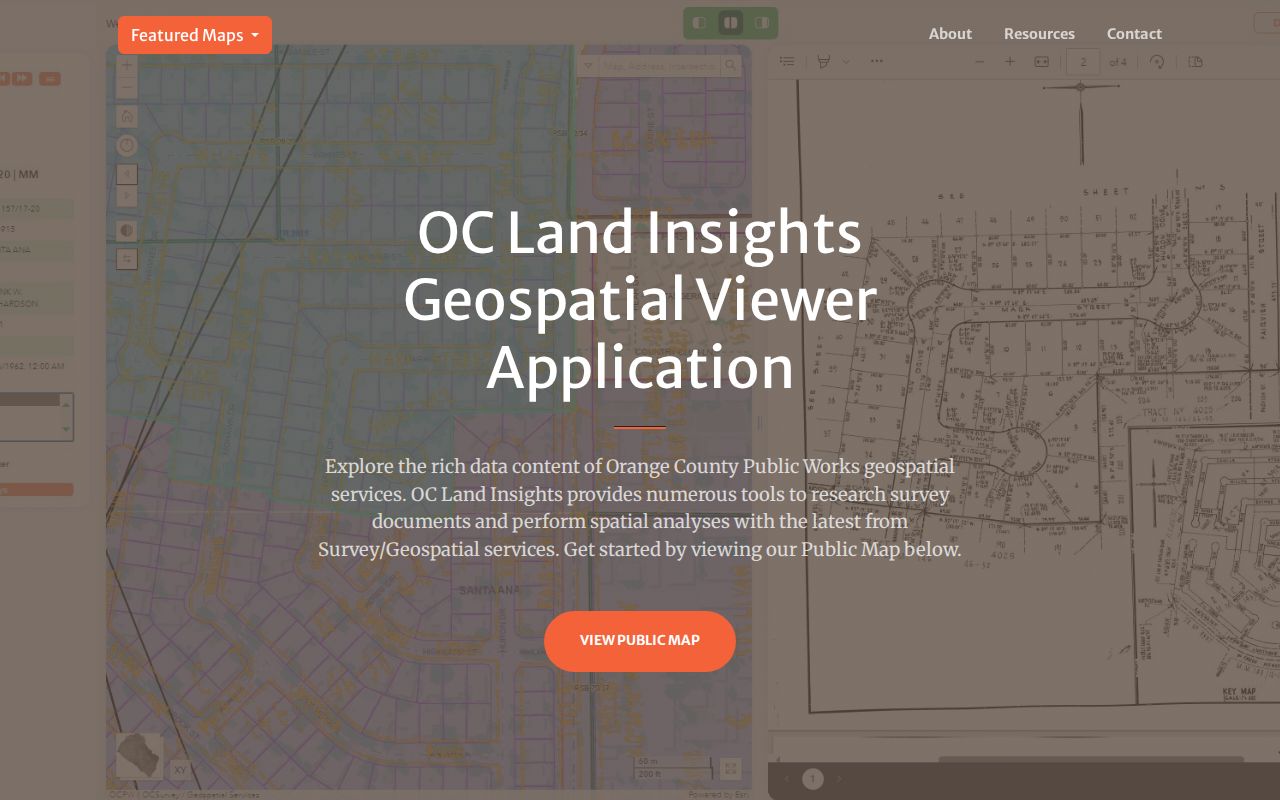
Once the target parcel is identified, repeat the same click process for side and rear parcels. Just do not assume a street-name search equals a complete roll.
Three Address Keys for Aliso Viejo Streets
Three address keys unlock any Aliso Viejo street search. The situs address is one. It points to the physical parcel on the ground. The mailing address is another, marking where tax notices and other mail travel, whether that is a post office box, a trust office, a manager, or a second home.
The third key is the legal description. Recorded with the county, it fixes the land's identity through lot, tract, map, and APN. An Aliso Viejo residents directory entry can blur these types together unless each label is read carefully.
- Parcel
- A mapped unit of land identified by an APN and tied to county assessment and map records.
- Situs address
- The physical location assigned to the parcel, distinct from the address used for notices.
- Plat or tract map
- A recorded map that shows how lots, blocks, streets, easements, or a subdivision were laid out.
- Criss-cross directory
- A reverse directory arranged by street and number, sometimes with a listed occupant or business and a telephone entry.
Match all three keys at every handoff. When a situs and mailing address agree, that helps a resident lookup lead, yet it still does not prove the owner lives on the parcel. A street number alone, without the tract or APN, can also tangle two Aliso Viejo properties that share a name or unit format.
RecorderWorks Along an Aliso Viejo Street
GIS hands you an APN. The assessment adds context. From there, the Orange County RecorderWorks Grantor-Grantee Index carries the trail forward. It indexes names and documents. It is not an address-first search, and it holds no online images of deeds. Instead, a searcher works with spelling variants, grantor or grantee roles, date ranges, document types, document numbers, or older book and page references tied to Aliso Viejo tracts. The rest of the county sits there too.
| Field Label | Type | Required | Format Notes |
|---|---|---|---|
| Grantor/Grantee Name | Text | Query-dependent | Try surname and business-name variants |
| From / To Date | Date pair | No | Recording date, not signing date |
| Document Type | Selector | No | Deeds, deeds of trust, releases, liens, reconveyances, and other recorded types |
| Document Number | Text | No | 1982 forward uses year plus a six-digit instrument number |
| Book / Page | Numeric text | No | Needed for older references where available |
| Search / Clear | Buttons | Action | Returns index entries; images are not displayed online |
What the index gives you is a set of pointers: grantors, grantees, party roles, recording dates, document types, and the instrument number or book-page location needed to order a copy. What it does not give is the deed itself. The text, signatures, consideration, legal description, return address, and any redactions all wait inside the recorded document.
Read the document type before naming an owner, too. A deed of trust is a loan instrument, not the acquisition deed that transferred title. The official RecorderWorks index is the starting point for building a street-level deed trail in the county records office system.
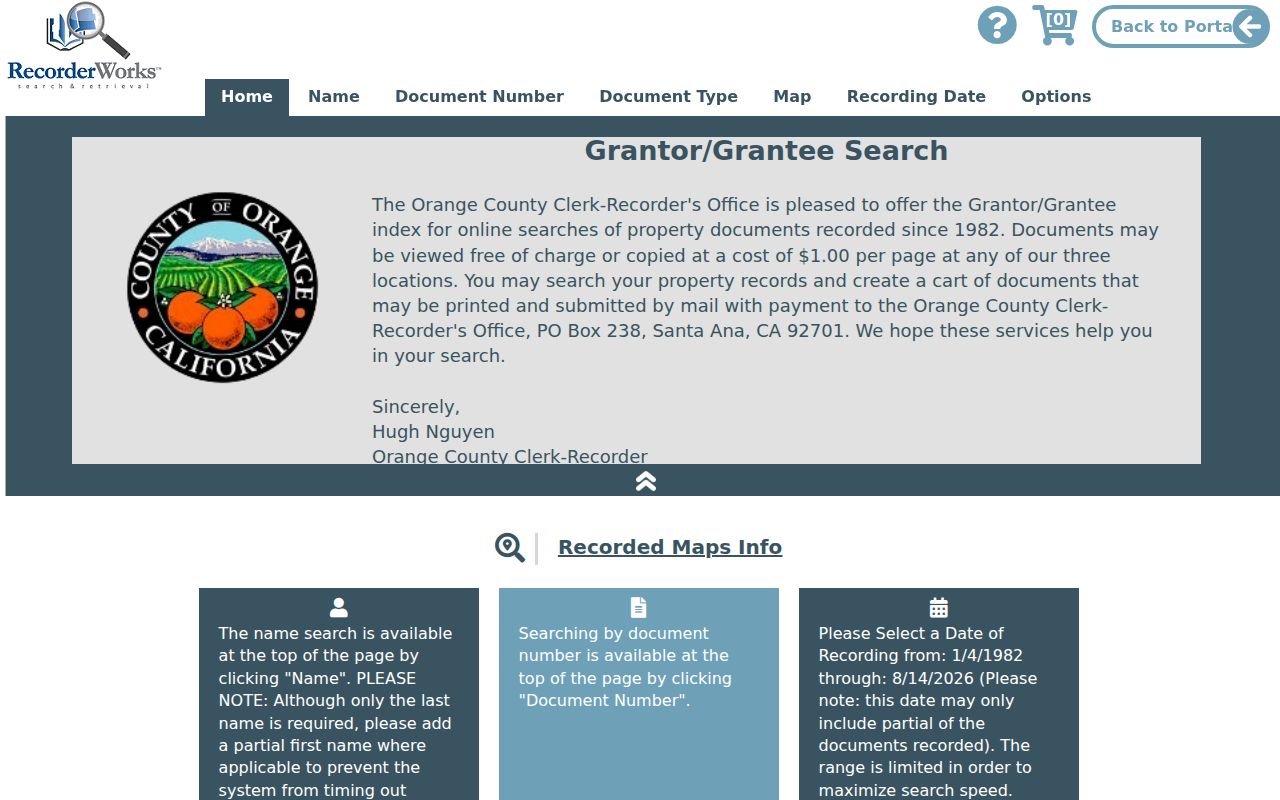
Treat every index result as a pointer, not a conclusion. The legal description and the recorded copy must tie the name to the parcel you are chasing, not to some other property elsewhere in Orange County.
Get the Deed After the Index
The Orange County Clerk-Recorder will not run a title search for you by phone, mail, or at the counter. Get the document number first, then order the copy. Records from 1982 forward use the recording year plus a six-digit instrument number. Anything earlier may call for book, page, and instrument details instead. That split matters for Aliso Viejo, because its first residential era began right around the same boundary, so tract and ranch research often follows a different index path.
Copies cost $1 per page, and certification adds $1 per document or map. Mail the request to 601 North Ross Street, Santa Ana, California 92701, with a self-addressed stamped envelope. The same Clerk-Recorder office handles in-person requests at 714-834-2500. When the modern index stops short of the era you need, older deed and property series can also be pursued through the Orange County Archives. Before relying on any address transfer entry, check the copy instructions as a checkpoint.
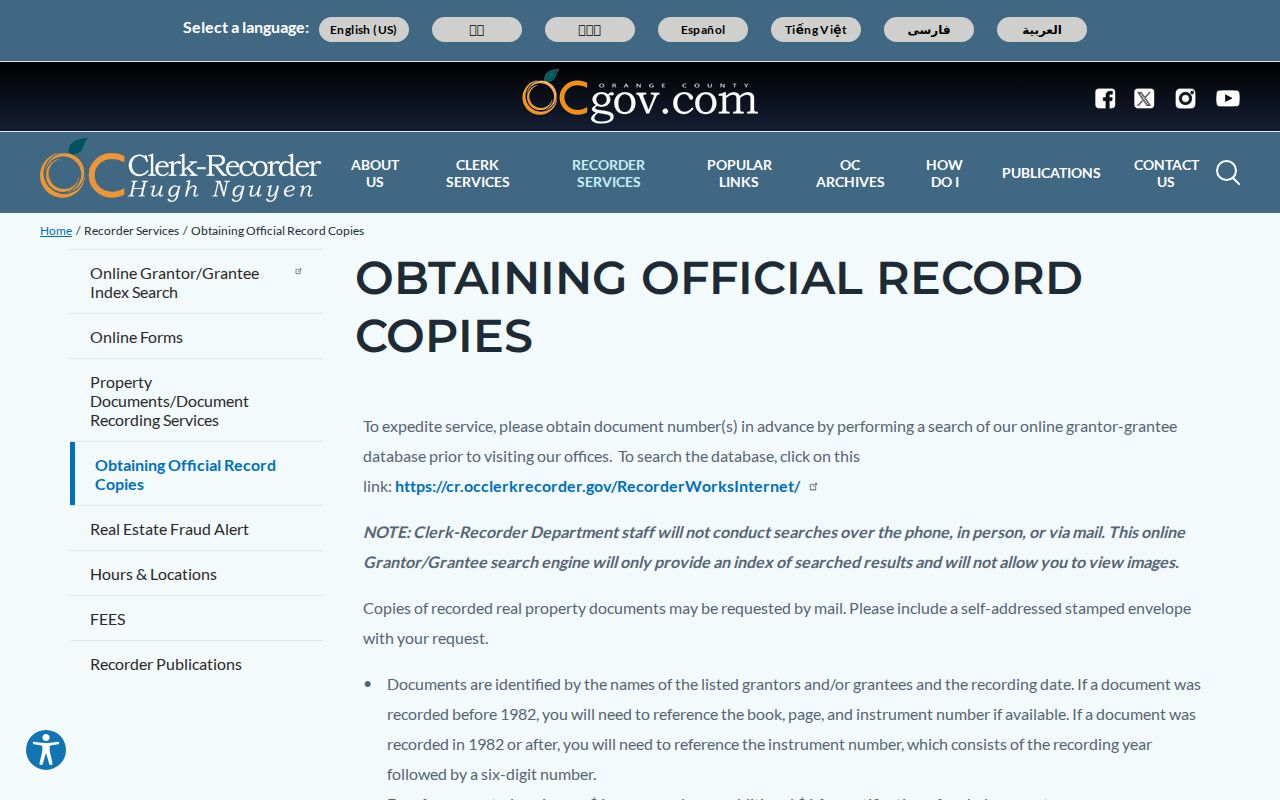
A certified copy serves formal record needs. An index entry alone is usually enough to decide which instrument to order. Keep the index number, document type, recording date, and parcel description together. Store them in one research log.
Note: A deed transfer names recorded parties and land rights. It does not name every person who occupied an Aliso Viejo address.
Aliso Viejo Permit Records by Street
Permit records put a physical timeline on an address. The City of Aliso Viejo keeps council agendas, minutes, and correspondence. It also holds contracts, planning entitlements, building permits, and plans. Code-enforcement records, business-registration files, and City maps round out the shelf. A permit can list the project address, applicant, or contractor. It may also show valuation, scope of work, issue and final dates, inspections, and scanned plans. That can date an addition or a change of use. It cannot tell you who lived there.
City Hall sits at 12 Journey, Suite 100. Government Services and the City Clerk share 949-425-2505, the main line is 949-425-2500, and Building questions run through 949-425-2540. The building counter opens Monday through Friday, 8 a.m. to 1 p.m. Last check-in comes at 12:30 p.m., with alternate-Friday closures. The City forms and permits hub links to the public-records, planning, building, code, and business-registration routes.
Sharpen the request before you send it. Name the address or APN and the date range. Add the permit or case number, the record series, and your preferred electronic format. The California Public Records Act calls for an initial determination ordinarily within ten days. It does not require full production of every file inside ten days. Under the California Attorney General's CPRA guidance, exemptions can shield active complaints, investigative material, drafts, or privileged advice. Details identifying a complainant may also be shielded. Copyrighted building plans may require an affidavit of intent, property-owner authorization, and a waiting period for a design professional's response.
One date matters more than any other here. The city did not exist before July 1, 2001. For earlier construction, subdivision, planning, or environmental records, ask Orange County instead of assuming City Hall holds the file. Deeds stayed with the county recorder while permit custody shifted at incorporation. That split is among the most useful facts in an Aliso Viejo street directory trail.
Walk the Aliso Viejo Block by Address
To inspect the immediate block, locate the target address in GIS, zoom until parcel outlines are clear, click the target, then click each side and rear parcel. Record every APN before opening the assessor or tax tools. The map supplies geometry and context; the assessor supplies APN-linked value and exemption fields; RecorderWorks supplies transfers after a name and document trail has been established.
Aliso Viejo’s street fabric largely follows the county-approved 1979 master plan and subdivisions built from 1982 forward. The principal and only verified city ZIP is 92656, but a ZIP is delivery geography, not a city boundary. Use the mapped municipal boundary and parcel jurisdiction when a street sits near an edge.
Address → GIS parcel → APN → secured-value roll → adjacent APNs → deed or permit records.
Sharing a fence line proves nothing. Physical adjacency is not a social tie or shared association. Aliso Viejo's master-planned layout includes common areas, private roads, and sub-association property. So neighboring parcels may answer to different custodians. The county GIS offers no radius or buffer tool. Pan, zoom, and identify are the dependable mechanics. Repeat the same parcel chain for each polygon rather than treating a ZIP or street name as a complete roll.
Reverse Directories in the Aliso Viejo Era
Reverse and criss-cross directories can bridge the gap between a deed transfer and a later address record. Local coverage is not fully documented. One verified environmental record for 26501 Aliso Creek Road cites Pacific Bell editions from 1997 and 1999 and Cole Information Services editions from 2009 and 2014. Those examples list businesses and users at the commercial address. Among them are Kmart, Little Caesars, Pizza Station, K Tyner, and Lowe's. They show the editions were used in a single property review, not that a complete residential run exists.
A typical directory entry may carry a name, spouse, occupation, address, or a householder mark. Reverse pages arrange a street and number alongside a telephone listing. Read abbreviations such as "r," "h," or "wid" against the volume's own key. Unlisted numbers and opt-outs leave gaps. An empty line in a book never proves an address had no occupant.
The Aliso Viejo Library sits at 1 Journey, reachable at 949-360-1730, with public computers, Wi-Fi, and catalog access. Branch hours run Monday through Thursday, 10 a.m. to 7 p.m., and Friday through Saturday, 9 a.m. to 5 p.m. Its official page does not enumerate a local reverse-directory or obituary run. So ask reference staff or search the OC Public Libraries catalog before counting on a given year. The historical collection question belongs with the Aliso Viejo city directory collections. Current parcel work stays with the address chain.
Note: The verified directory examples are property-specific and do not prove a complete Aliso Viejo residential run.
Aliso Viejo Street, City, and AVCA Records
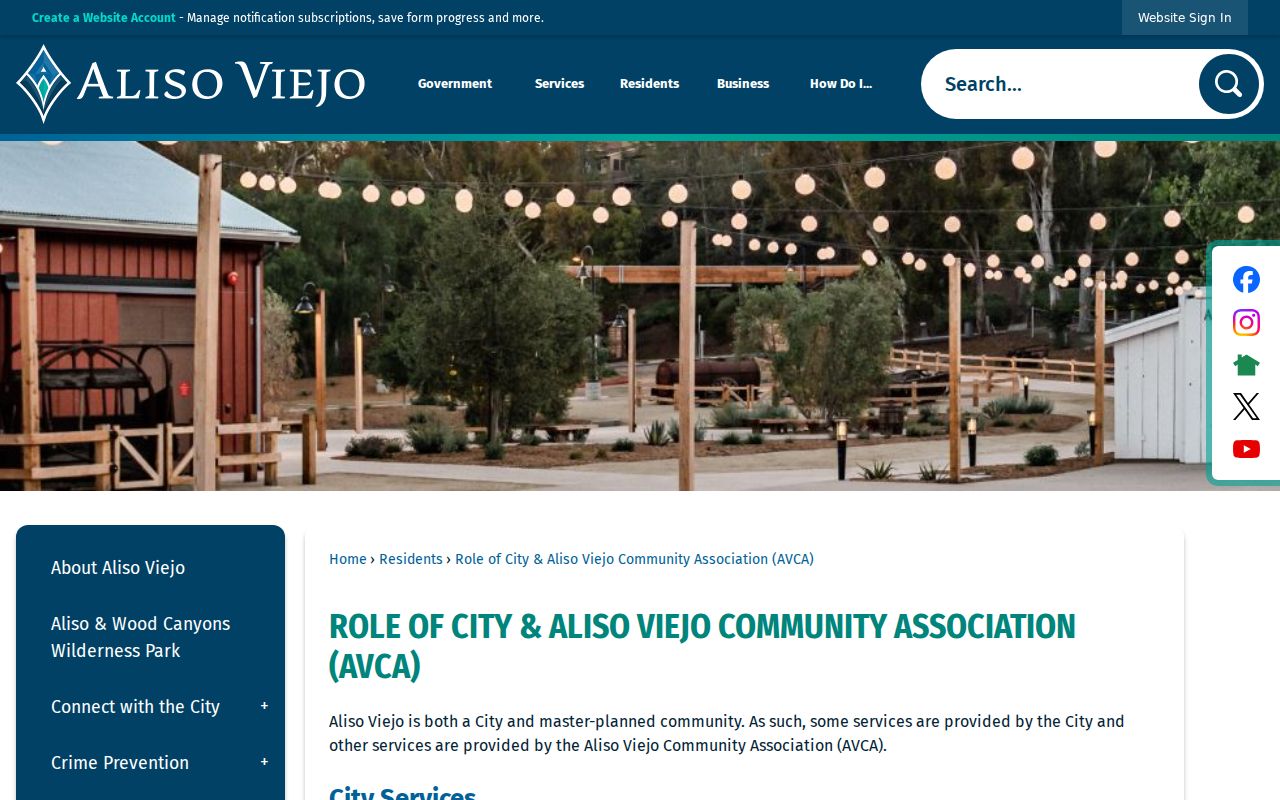
One address can cross three local record systems. The City handles building, fire safety, planning, police, and public works. AVCA, the Aliso Viejo Community Association, is the master association for the city. It maintains many parks, greenbelts, parkways, and slopes, and it enforces the CC&Rs. Sub-associations and private owners control other common areas and private roads. The right custodian depends on the question at hand. It could be a public permit, a parcel, or private common-area governance.
The City's explanation of the City and AVCA roles sets the boundary. That boundary shapes any street records search in Aliso Viejo.
The Aliso Viejo Community Association sits at 949-243-7750, and the City's own resource pages point residents toward civic groups like American Legion Saddleback Valley Post 862 and Friends of Aliso Viejo Library. None of these groups publishes a full members directory. There is no complete sub-association roster in any residents directory or public record set either. Think of each organization's contact point as a door for asking about governance records, not as a license to hunt for private membership lists.
Limits on the Aliso Viejo Address Directory
No public record set hands you a complete roster of who lives at every Aliso Viejo address. Each record type covers only its own slice. A deed names the parties who recorded it. The assessor's web result leaves the owner name out. A permit names an applicant or a contractor. Voter tools work the same way, with tight limits on street directory style browsing by address.
California My Voter Status asks for a first name, last name, and full date of birth. It also asks for either a California driver-license or ID number or the last four digits of a Social Security number when needed. Match yourself and the system can show your registration address, party and language preferences, polling place, election information, and ballot-status details. It never shows ballot choices. The state's registration-status guidance and the county's application route draw a clear line between self-lookup and controlled access. That line marks the edge of the whole voter file.
The Orange County route is heavier. Voter-file requests demand an original wet signature, payment, supporting documentation, and a photocopied official photo ID for mail delivery. You can submit in person or by mail. The address is the Registrar of Voters, 1300 South Grand Avenue, Building C, Santa Ana, California 92705. The county phone is 714-567-7600; the state voter line is 800-345-VOTE. Data may be picked up or shipped for a fee. Full-file access is limited under Elections Code sections 2188 and 2194 and related rules. Safe at Home participants use confidential registration channels instead. No official catalog lists historical poll books or registers, so a library or archive is not a guaranteed fallback for past voters.
Other walls surround the Aliso Viejo residents directory too. DMV personal information is restricted by the federal Driver's Privacy Protection Act, and utility customer lists are not general public directories. California privacy rights for covered business-held data support know, delete, correct, and sale or sharing opt-out requests. Yet those rights cannot erase deeds or required government records. Active code complaints, police material, protected court files, sealed records, and confidential vital records can all be withheld or redacted. A commercial address tool may compile stale or misattributed data. But it cannot override a custodian's access rules or turn a partial hit into a household fact.
Lawful use. Use Aliso Viejo parcel and address records for lawful personal, family-history, property, or civic research. California stalking and criminal-threat laws, civil-harassment remedies, voter-data restrictions, and other privacy rules still apply. Never use a record to stalk, harass, threaten, or intimidate a person.
A missing record calls for the right custodian. That means the City Clerk for a city file and the Assessor for roll information. The Clerk-Recorder holds recorded documents. Elections staff handle voter data. Older material sits with the relevant archive, and a clear request for a defined record series beats a demand for an all-purpose Aliso Viejo address directory.